Three Types of AI Agents Every Marketer Needs to Know
Agents for marketers, agents exposed to customers, and buyer-side agents,a practical breakdown of all three AI agent types and exactly when to use each one.
Digital Marketing
Aug 4, 2026
10 min readBy Chandu Thomas
Introduction
For the last few years, "AI in marketing" meant one thing: a tool that helped you do your job faster. Write the email. Draft the ad copy. Segment the list. That's still true , but it's no longer the whole story.
Three distinct types of AI agents now touch your marketing function, and they don't do the same job at all. Most guides on AI agents for marketing pick one of these three and go deep , a tool round-up, a customer-experience playbook, or a think-piece on agentic commerce. That's the gap this guide closes: a single framework for all three, so you know exactly which one you're building, buying, or optimizing for at any given moment.
The three types, at a glance:
- Agents for marketers , internal tools that execute marketing tasks on your behalf
- Customer-facing agents , outward-facing systems that represent your brand in real time
- Buyer-side agents , AI assistants your customers bring with them, which you don't control at all
What Are AI Agents (In a Marketing Context)?
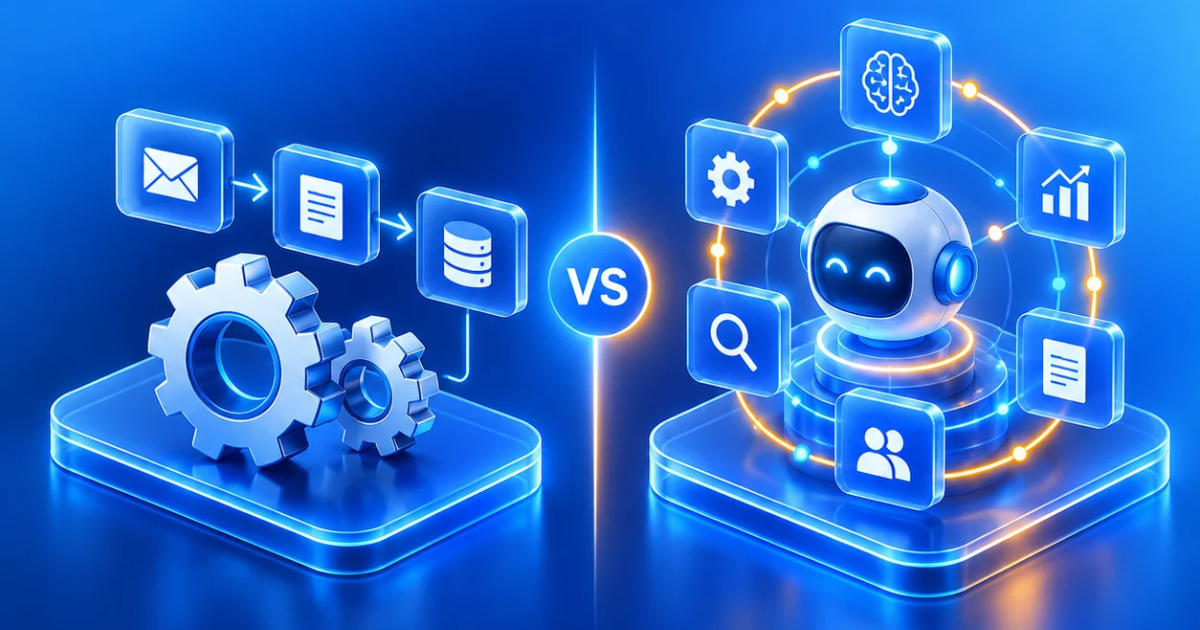
An AI agent is different from a chatbot or a one-shot generative tool. A generative AI tool responds once to a prompt , you ask, it answers. An agent can plan a sequence of steps, pull data from connected systems, take action, evaluate its own output, and adjust , with a human reviewing at defined checkpoints rather than approving every micro-step.
In marketing specifically, this distinction matters because agentic AI is quickly becoming one of the fastest-growing search and adoption categories in the industry , but "AI agent" isn't one thing. Depending on who it serves and who controls it, an agent falls into one of the three categories below, and each carries different risks, owners, and success metrics.
1. Agents for Marketers: Your New Execution Layer

These are the agents doing what you'd otherwise do yourself, or hand to a coordinator: writing content, managing ad bids, building segments, monitoring keyword rankings, drafting campaign briefs.
Common flavors:
- Content agents , draft blog posts, ad variations, and social copy, often matching brand voice automatically
- Email and lifecycle agents , manage send timing, subject-line testing, and list hygiene
- Ad optimization agents , adjust bids and swap creative based on real-time performance
- SEO and search agents , track rankings, surface content gaps, suggest on-page fixes
- Segmentation and analytics agents , cluster audiences and forecast behavior from historical data
When to use this type: anywhere you have a repeatable, well-scoped task with a clear success metric , campaign execution, reporting, first-draft content, routine optimization. This is the lowest-risk category to adopt first, because the agent's output stays inside your team until a human signs off.
Where it breaks down: high-stakes brand decisions, anything requiring judgment about tone in a sensitive moment, or tasks where the "right answer" changes based on context an agent can't see. Treat these as copilots, not autopilots.
2. Customer-Facing Agents: Your Brand's Front Door, Automated

Instead of assisting your team, the agent is the interaction , a chat or voice interface a customer talks to directly, representing your company in real time. Think a retail brand's shopping assistant that recommends products from facial-recognition input, or a support agent that resolves a billing question without a human in the loop.
The distinction that matters here: a customer-facing agent isn't just a scripted chatbot. It reasons over context, remembers the conversation, and can take real action , issue a refund, rebook an order, escalate appropriately , rather than routing to an FAQ.
When to use this type: high-volume, well-defined customer interactions where consistency and speed matter more than a human touch , order status, product recommendations, tier-one support, appointment scheduling. Brands that have deployed these well report significant reductions in support cost and faster resolution times.
Where it breaks down: anything emotionally charged , a complaint, a cancellation tied to a life event, a complex issue spanning multiple problems. Customers can tell when they've hit a wall with a bot, and a bad hand-off does more brand damage than the agent saved in labor. Build an explicit, fast escalation path to a human, and treat that path as a feature, not a failure state.
3. Buyer-Side Agents: The Customer You Can No Longer See Directly

This is the category most marketing teams are least prepared for, because it isn't a tool you deploy , it's a shift in who's doing the deciding on the other side of the funnel. Buyer-side agents are AI assistants your customers control , ChatGPT, Perplexity, Gemini, Claude, and increasingly checkout-enabled shopping agents , to research options, compare products, and in a growing number of cases, complete the purchase.
This matters because it breaks the assumptions most marketing strategy is built on. A human researching a purchase clicks through your site, sees your design, reads your reviews section, forms an impression. An agent researching on a human's behalf reads your content differently , it's pulling structured facts, comparing claims across sources, and forming a recommendation the human may never fully see the reasoning behind. Traffic from these interactions often shows up as a "zero-click" journey: the agent did the research, gave a recommendation, and your site never got the visit.
The practical shift: the fundamentals of earning trust haven't changed, but the audience partly has. Where you used to optimize for a human scanning a search results page, you now also need content that reads clearly to a model doing comparison and synthesis , accurate, structured, consistent across every place you publish, because inconsistency is exactly what erodes an agent's confidence in recommending you. This is the essence of marketing to AI agents, sometimes called AEO or GEO (answer engine / generative engine optimization).
When to focus here: if your buyers are increasingly doing early-stage research through AI tools rather than search , common in considered-purchase categories like software, financial services, and higher-cost consumer goods , this deserves real investment now, not once it's obviously mainstream. If your sales cycle is short and impulse-driven, it's lower priority for now, but worth monitoring.
Where it gets uncertain: this is the newest and least standardized category. Attribution is murky, the platforms are still defining the rules (agentic checkout protocols, agent-to-agent negotiation standards), and best practices are being written in real time. Treat early moves here as experiments with a feedback loop, not a finished playbook.
Putting the Three Types Together
|
|
Who it serves |
Who controls it |
Primary risk if you ignore it |
|
Agents for marketers |
Your team |
You |
Slower execution, competitors ship faster |
|
Customer-facing agents |
Your customers |
You |
Inconsistent brand experience, support backlog |
|
Buyer-side agents |
Your customers |
The customer / platform |
Invisible to a growing share of your funnel |
The mistake to avoid is treating these as one continuous "AI strategy" with a single owner and a single roadmap. They sit in different parts of the organization, carry different risks, and move at different speeds. The teams getting this right build all three in parallel: using internal agents to move faster, deploying customer-facing agents where the interaction is well-defined enough to automate safely, and , the piece most roadmaps still miss , treating buyer-side agents as a new audience to earn trust with, not just a traffic-source anomaly to explain away in a quarterly report.
Conclusion
The brands that only build category one are optimizing efficiency. The ones building all three are the ones still getting chosen when the buyer never visits their homepage at all.
Knowing the difference between these three types of AI agents is step one. Actually building a strategy that covers internal execution, customer-facing experience, and visibility to the AI agents now doing research on your buyer's behalf is a different job entirely , one most marketing teams aren't structured for yet.
If you're trying to figure out where your brand stands with buyer-side agents specifically, or want a second set of eyes on your AI-agent roadmap across all three categories, SearchAlly works with marketing teams on exactly this , from AEO/GEO visibility to agentic execution strategy. Get in touch to see where the gaps are in your current setup.
Related Services
Content Marketing
Paid Media Services
Content Marketing
Web Development Services
Content Marketing