What Are AI Agents in Marketing?
AI agents are changing how agencies work, handling reporting, reviews, and follow-ups on their own. Here's a guide to what they are and how to start.
Digital Marketing
Jul 20, 2026
12 min readBy Chandu Thomas
It's Friday Afternoon. Again.
Your team spent the week buried in it again - pulling performance reports at midnight, copy-pasting lead details into email drafts, manually posting content across six platforms, scrolling through Google reviews trying to keep up with replies. Meanwhile, the strategy work your clients actually pay you for? Pushed to Friday. Again.
If that sounds familiar, you're not alone. Nearly every agency leader we talk to describes the same slow drain: talented people grinding through repetitive, time-consuming tasks that a machine could handle - if only you had the right machine.
That machine exists now. It's called an AI agent. And by the end of this guide, you'll understand exactly what it is, how it works, and which one to try first - even if you have zero technical background.
Let's Clear Up the Confusion First
When most people hear "AI," they picture ChatGPT - a chat box where you type a question and get an answer. That's a useful tool, but it's one narrow slice of what AI can do in your agency.
Think of it in three levels:
- AI tools - Do one thing when you ask. ChatGPT writes a caption when you prompt it. You're doing the thinking; it's doing the typing.
- AI automation - Do one thing on a schedule. Zapier publishes your blog post every Tuesday. No thinking involved - just triggering a preset action.
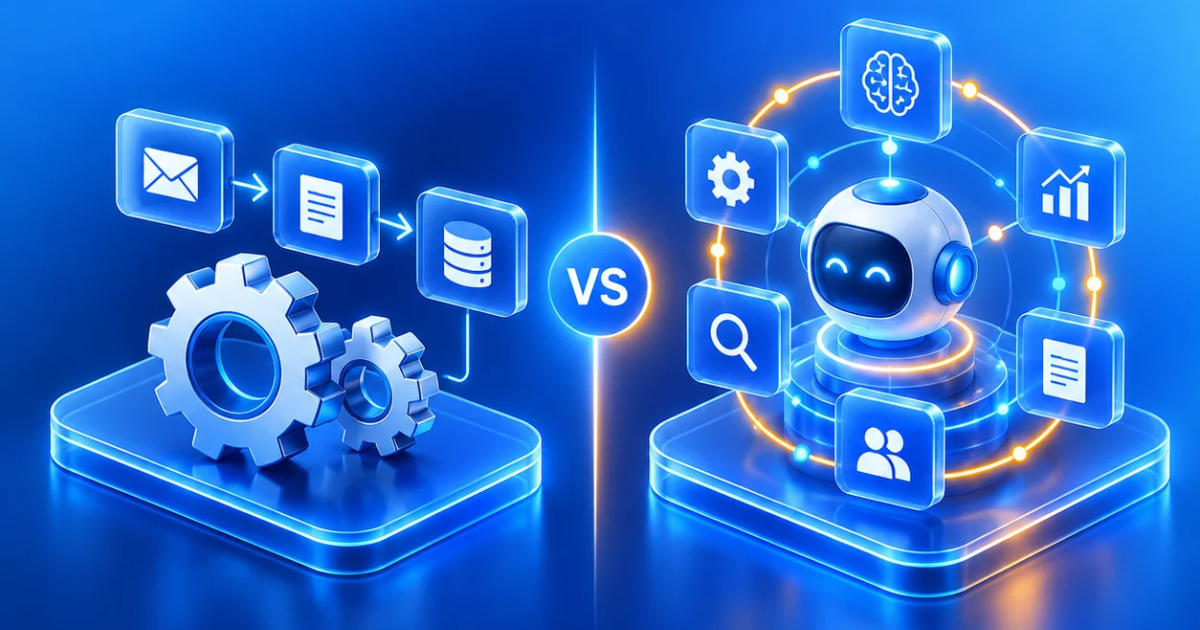
- AI agents - Think, decide, and act across multiple steps on their own. You give them a goal; they figure out the path.
The best analogy: a chatbot is like a calculator - push a button, get an answer. An AI agent is like a capable new junior hire - give them a goal, and they figure out what needs to happen to get there, step by step, without you micromanaging every move.
So What Exactly Is an AI Agent?
Here's a plain-English definition: an AI agent is software that can perceive information, make decisions, use tools, and take actions - repeatedly - to complete a goal without you managing every step.
Every true AI agent has four key properties:
- Perception - It reads. Emails, reviews, spreadsheets, web pages, ad dashboards - anything you give it access to.
- Reasoning - It decides what to do next based on what it found, not based on a fixed rule you wrote in advance.
- Action - It can actually do things: send emails, post replies, update spreadsheets, flag issues, create reports.
- Memory - It remembers what it already did so it doesn't repeat itself or lose context mid-task.
You can also run multiple agents together - what's called a multi-agent system. For example, one agent monitors your ad performance and flags anomalies, while a second agent drafts a client alert and a third logs the issue in your CRM. Each agent is focused on one thing; together, they handle a workflow that previously required three people.
How AI Agents Are Different from the Marketing Automation You Already Use
You're probably already using tools like Zapier or Make. Those are powerful - but they're rule-based. They do exactly what you tell them to do, every time, the same way. The moment something unexpected happens, they break.
Old automation works like this: if X happens, do Y. It's rigid, predictable, and great for simple repeating tasks. AI agents work differently: if X happens, figure out what Y should be, do it, check if it worked, and adjust.
The key difference is that agents handle exceptions, not just the happy path. Here's a concrete example. A standard automation posts your blog to social media. An AI agent notices the post got low engagement, rewrites the caption with a different angle, reposts at a higher-traffic time, and logs what worked - all without you lifting a finger. That's not just automation. That's judgment.
Real Marketing Tasks AI Agents Are Already Doing
This isn't theoretical. Right now, agencies are using AI agents to handle tasks like these:
Review Management
Detects new Google or Yelp reviews, generates a personalised response matched to the tone and content of the review, sends it to you for one-click approval, then posts it live on confirmation.
Lead Follow-Up
A new contact form submission comes in. The agent looks up the lead's LinkedIn and website, drafts a personalised first email relevant to their business, and sends it to your outbox for review before it goes out.
Content Repurposing
One long-form blog post automatically becomes three LinkedIn posts, a newsletter summary, and a handful of short-form social captions - all formatted correctly for each platform.
SEO Monitoring
The agent checks your tracked keyword rankings weekly, flags any drops above your set threshold, and drafts a report with potential reasons and suggested fixes.
Competitor Tracking
Monitors competitor websites and social pages. Alerts you when they launch a new service page, publish a case study, or run a new ad campaign.
Ad Performance Alerts
Watches your Meta and Google Ads spend and cost-per-acquisition in real time. Flags anomalies before a budget burns - and can pause campaigns automatically if you've enabled that permission.
Client Reporting
Pulls data from Google Analytics 4, Search Console, and your ad platforms. Drafts a client-ready report in your template. Emails it to you for review before it goes to the client.
The "Brain" Behind the Agent - How It Actually Thinks
You don't need a computer science degree to understand this. Here's the short version.
AI agents are powered by large language models (LLMs) - the same technology behind ChatGPT and Claude. The LLM is the reasoning engine. It reads the situation, decides what to do, and chooses which tools to use.
Those tools are the agent's hands. They connect to the real world - web search, email, spreadsheets, your CRM, ad platforms, anything with an API. The LLM thinks; the tools act.
You control the agent through prompts - written instructions that define the goal, the rules, and what the agent should and shouldn't do. Think of it as writing a job description for a very capable hire.
Memory works in two ways: short-term (what the agent knows within a single task) and long-term (information stored in a database or document that the agent can look up across tasks). This is what lets an agent remember a client's tone preferences or the last time it posted to a particular account.
What AI Agents Cannot Do (Let's Be Honest)
AI agents are not magic. Here's what they genuinely struggle with:
- They make mistakes - especially with nuanced brand voice, sensitive client relationships, or situations that require human judgment and empathy.
- They need human checkpoints - any output that goes externally to a client or to the public should have a human approval step in the workflow. This is non-negotiable.
- They work best on repetitive, rule-followable, data-driven tasks - not on creative strategy, new business pitches, or high-stakes relationship decisions.
- They require upfront setup - they are not plug-and-play out of the box. Expect to invest a few hours configuring your first agent properly.
- They carry data privacy responsibilities - be thoughtful about what client data you feed into any AI system, and review the data policies of any platform you use.
The right approach is semi-autonomous agents - they do the heavy lifting, you make the final call on anything that matters. That's not a weakness; it's smart design.
The Tools You Can Use to Build or Buy AI Agents
You have two paths: build your own or buy a pre-built product. Here's a breakdown for both types of agency.
No-Code / Low-Code (For Non-Technical Agency Owners)
- n8n - Open-source and locally hostable, making it ideal for agencies handling sensitive client data. Excellent for building multi-step agent workflows visually.
- Make.com with AI modules - The familiar automation platform now includes AI steps. If your team already uses Make, adding AI capabilities is a natural next step.
- Relevance AI - Purpose-built for building AI agents without code. Strong library of pre-built templates for marketing workflows.
- AgentGPT / AutoGPT interfaces - Browser-based tools for experimenting with autonomous agents. Best for testing and exploration before committing to a production build.
For Agencies with a Developer or Technical Team
- LangChain / LangGraph - The most widely used framework for building custom LLM-powered agents in Python. Highly flexible; steeper learning curve.
- CrewAI - Specifically designed for multi-agent systems. Well-suited for complex marketing workflows where different agents handle different functions.
- OpenAI Assistants API - Pre-built agent infrastructure from OpenAI. Good for agencies already using GPT models and wanting to add tool use quickly.
- Anthropic Claude API with tool use - Strong option for agencies prioritising safety, careful reasoning, and nuanced content tasks.
Ready-Made Agent Products
- Jasper - AI content agent for writing and repurposing marketing content at scale.
- Surfer SEO AI - AI-assisted content optimisation and SEO workflow automation.
- Instantly / Reply.io - Outreach agents for email sequences, lead follow-up, and inbox management.
How to Know If Your Agency Is Ready
Answer yes or no to these four questions:
- Do you have at least one task your team does manually more than three times a week?
- Do you have basic tools already connected - Google Workspace, a CRM, or an ad platform?
- Is someone on your team comfortable with tools like Zapier or Make, even just a little?
- Do you have four to six hours available to set up and test a first workflow?
If you answered yes to two or more of those questions, you are ready to start with a small pilot agent this week. You don't need to be fully ready - you just need one clear use case and the willingness to try.
Where to Start: A 3-Step Entry Plan
The biggest mistake agencies make with AI agents is trying to automate everything at once. One working agent beats five half-built ones. Here's the smarter path.
Step 1 - Pick One Painful, Repetitive Task
Review replies, weekly client reporting, and lead follow-up are the easiest wins. Pick the one that burns the most hours or causes the most friction right now. Write down exactly what your team currently does, step by step. That becomes your agent's brief.
Step 2 - Build or Buy a Single-Task Agent
Focus on one task only. Use one of the no-code tools above if you don't have a developer, or a ready-made product if your task is a standard workflow. Keep a human approval step in the loop for anything that goes externally. This protects your client relationships while you're still learning what the agent can and can't handle.
Step 3 - Measure and Expand
Track time saved over 30 days. Compare output quality to what your team was producing manually. If the agent is saving at least two hours per week and maintaining quality with your edits, it's working - and it's time to pick a second use case.
The Bigger Picture: What This Means for Your Agency's Future
The agencies that move early on this won't just save time. They'll deliver faster, at lower cost, with more consistency - and that compounds into a competitive advantage that is very difficult for slower-moving competitors to close.
This is not about replacing your team. The work that requires genuine human judgment - creative strategy, client relationships, new business, culture - agents cannot do. What they can do is absorb the volume work underneath that strategy: the monitoring, the reporting, the drafting, the scheduling, the follow-up.
The agency of 2027 won't have more people doing more tasks. It will have the same people doing higher-value work, with agents handling the volume underneath. The difference between the agencies that thrive and the ones that struggle will be simple: who started building now.
Start small. Start this week. One agent, one task, one month of data. That's all it takes to begin.
Glossary: Key Terms Explained Simply
- AI Agent: Software that perceives information, reasons about it, takes action, and remembers results - repeatedly - to complete a goal.
- LLM (Large Language Model): The AI reasoning engine (like GPT-4 or Claude) that powers the agent's thinking and decision-making.
- Prompt: The written instructions you give an AI agent that define its goal, constraints, and how it should behave.
- Tool Use: The ability of an agent to connect to and use external systems - email, web search, spreadsheets, CRMs - to take real-world actions.
- Workflow: A defined sequence of steps an agent follows to complete a task from start to finish.
- Webhook: A trigger mechanism that tells an agent to start when something happens in another system (e.g., a new form submission).
- Multi-Agent System: Multiple AI agents working together, each handling a different part of a larger workflow.
- RAG (Retrieval-Augmented Generation): A technique that lets an agent look up information from your own documents or database before generating a response - keeping it accurate and relevant to your specific context.
- Autonomous vs Semi-Autonomous: Autonomous agents act entirely without human input. Semi-autonomous agents (recommended for most agency use cases) pause for human approval at key steps before taking action.
Conclusion
The agencies that move early on AI agents won't just save time, they'll deliver faster, more consistent work at lower cost, building an edge that's hard for slower competitors to close. This isn't about replacing your team; it's about freeing them from volume work so they can focus on the strategy clients actually pay for.
The agency of 2027 won't need more people doing more tasks. It'll have the same people doing higher-value work, with agents quietly handling the rest.
You don't need a five-agent rollout to get started. You need one task, one workflow, and thirty days of data.
Ready to build your first AI agent? At Searchally Agency, we help marketing teams identify the right first use case, set it up with the right guardrails, and measure the results, without the trial-and-error most agencies go through alone. Get in touch to map out your agency's first AI agent.
Related Services
Content Marketing
Paid Media Services
Content Marketing
Web Development Services
Content Marketing